


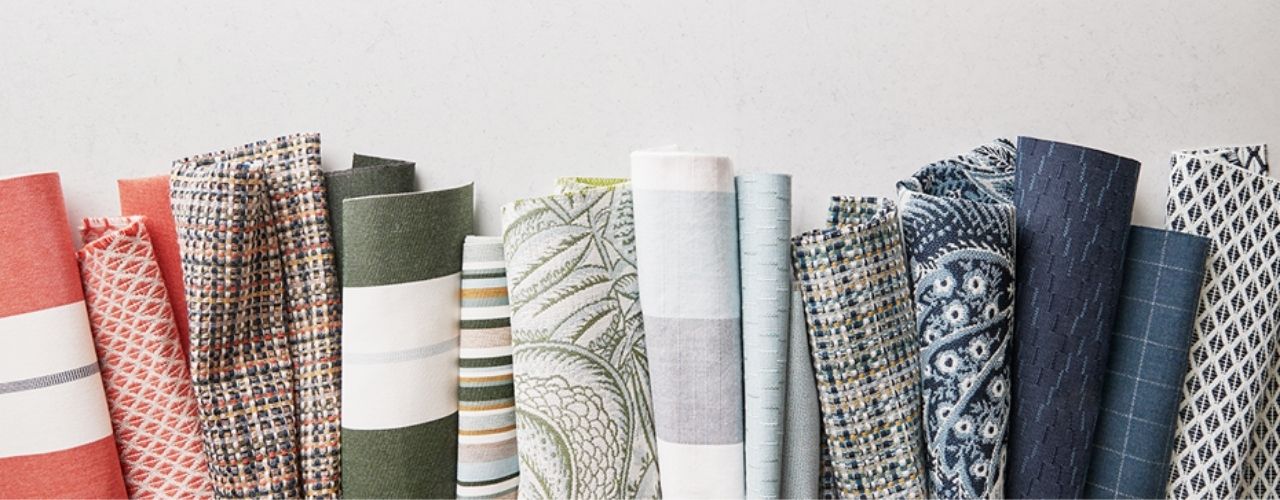
About Our Fabrics
Comparing Performance to Sunbrella® Fabric
When it comes to premium outdoor textiles, Sunbrella® is the industry standard for fade resistance, durability, and long-term performance. Below, you’ll find a breakdown of other popular fabric types—each compared to Sunbrella—to help you choose the right solution for your project.
Acrylic-Coated Polyester
Main Street™ Plus
- Compared to Sunbrella: While Sunbrella uses a breathable solution-dyed acrylic yarn, Main Street™ Plus relies on an acrylic coating over polyester, which makes it more rigid and less breathable.
- Best for: Awnings and canopies where dimensional stability and water resistance matter more than softness or breathability.
- Applications: Decorative panels, banners, duffel bags, patio furniture covers.
- Key Difference: Sunbrella is softer and more comfortable for cushions and upholstery, whereas Main Street™ Plus is better for heavy-duty covers and structured uses.
Solution-Dyed Woven Acrylics
Sunbrella®
- The gold standard for fade resistance, weatherproofing, and versatility.
- Available for marine, awning, and furniture use, with warranties of 10 years (awning/marine) and 5 years (furniture).
Outdura®
- Compared to Sunbrella: Like Sunbrella, Outdura is also a solution-dyed acrylic, offering excellent fade resistance. Outdura is stiffer, which some fabricators prefer for sewing boat covers and awnings.
- Warranty: 6 years (vs. Sunbrella’s 10 years for awning/marine).
- Best for: Marine applications where a slightly heavier hand is desired.
Dickson® Awning & Marine Fabrics
- Compared to Sunbrella: Dickson is also part of the Sunbrella family (Glen Raven owns both brands). Its water-repellent finish resists dirt and mildew, but Sunbrella has broader brand recognition in the U.S.
- Warranty: 5 years (vs. Sunbrella’s 10 years).
- Best for: Awnings and decorative outdoor projects when European styles and striping options are desired.
Vinyl-Laminated Polyester
Patio 500 Vinyl
- Compared to Sunbrella: Unlike Sunbrella’s breathable acrylic yarns, Patio 500 is a vinyl-laminated polyester—completely waterproof but less breathable.
- Best for: Commercial awnings in hot, humid climates where mildew resistance and waterproofing are top priorities.
- Warranty: 5 years.
- Key Difference: Sunbrella provides comfort and breathability, while Patio 500 excels in tough, waterproof installations.
Solution-Dyed Acrylic with Coating
Outdura Trio®
- Compared to Sunbrella: While Sunbrella is breathable and water-repellent, Outdura Trio adds a laminated layer that makes it both waterproof and breathable—a rare combination.
- Best for: Boat covers, Bimini tops, and enclosures that demand waterproofing beyond what Sunbrella typically offers.
- Warranty: 6 years.
- Key Difference: Sunbrella prioritizes breathability and comfort, while Outdura Trio emphasizes waterproofing for marine use.
Engineered Polyester Textiles
Ferrari Précontraint® (502, 532, 542, Soltis 86/92/Air)
- Compared to Sunbrella: Ferrari fabrics are composite membranes engineered for tensile architecture, whereas Sunbrella is a woven textile.
- Best for: Large-scale structures, shade sails, and tensile roofs.
- Key Difference: Sunbrella suits awnings, furniture, and marine, while Ferrari specializes in architectural performance membranes.
Phifertex®
- Compared to Sunbrella: Phifertex is a vinyl-coated polyester mesh, offering excellent strength and airflow, but not as soft or comfortable as Sunbrella for seating.
- Best for: Outdoor furniture inserts, sling chairs, umbrellas.
- Key Difference: Sunbrella is better for cushions/upholstery, while Phifertex shines in sling and structural mesh applications.
Phifertex® Plus
- Compared to Sunbrella: Denser than standard Phifertex, designed specifically for slings and umbrellas. Unlike Sunbrella, it is PVC-coated and not ideal for upholstery comfort.
- Key Difference: Better tensile strength for slings; Sunbrella remains superior for soft seating.
Weblon – Herculite Utility & Economy
- Compared to Sunbrella: More economical and industrial-focused, with flame and mildew resistance but without Sunbrella’s comfort or design variety.
- Best for: Covers and curtains in industrial environments.
Coastline Plus™
- Compared to Sunbrella: A vinyl-laminated polyester offering waterproofing and durability, but stiffer than Sunbrella.
- Best for: Waterproof awnings and marine enclosures.
- Key Difference: Sunbrella offers a textile feel, while Coastline Plus provides vinyl toughness.
PVC or Vinyl-Coated Woven Polyester (Mesh, Shade & Sling Fabrics)
Sunsure®
- Compared to Sunbrella: Sunsure offers up to 92% shade, but like other PVC-coated fabrics, it lacks Sunbrella’s soft textile feel.
- Best for: Umbrellas and shade structures.
Textilene® (Standard, Plus, 80, 90)
- Compared to Sunbrella: Textilene is a vinyl-coated mesh, breathable and durable, but not ideal for upholstery comfort.
- Textilene Standard: General outdoor mesh use.
- Textilene Plus: Stronger mesh with 76% shade, waterproof and mildew resistant.
- Textilene 80 & 90: Solar screen versions, blocking 80–90% of UV rays for energy efficiency.
- Key Difference: Sunbrella provides a premium woven acrylic fabric for cushions and awnings, while Textilene excels in shading and sling mesh applications.
AwnTex®
- Compared to Sunbrella: Similar in shading use but more open-weave for airflow. Sunbrella offers stronger colorfastness and warranty confidence for awnings.
- Best for: Shade structures like playgrounds and umbrellas.
Summary: Why Choose Sunbrella First?
While many specialty fabrics excel in niche applications—waterproof vinyls, industrial meshes, architectural membranes—Sunbrella remains the most versatile option. With unmatched fade resistance, superior comfort, and broad warranties, it is the go-to choice for awnings, cushions, marine upholstery, umbrellas, and more. Other fabrics may outperform Sunbrella in specific technical applications (e.g., complete waterproofing or tensile structures), but for most outdoor living and design projects, Sunbrella is the proven leader.
